In this article: ‘What would it be like to… take up ballet?’
I often ask myself, ‘What would it be like…?’ to do or experience a certain activity or situation. And whenever possible, I actually put it to the test. Driven, it seems, by a huge curiosity, I am eager to discover the (physical and mental) experience of a specific situation, activity, adventure or situation. I want to know what it would be like or like… To explore or push my own boundaries for example.
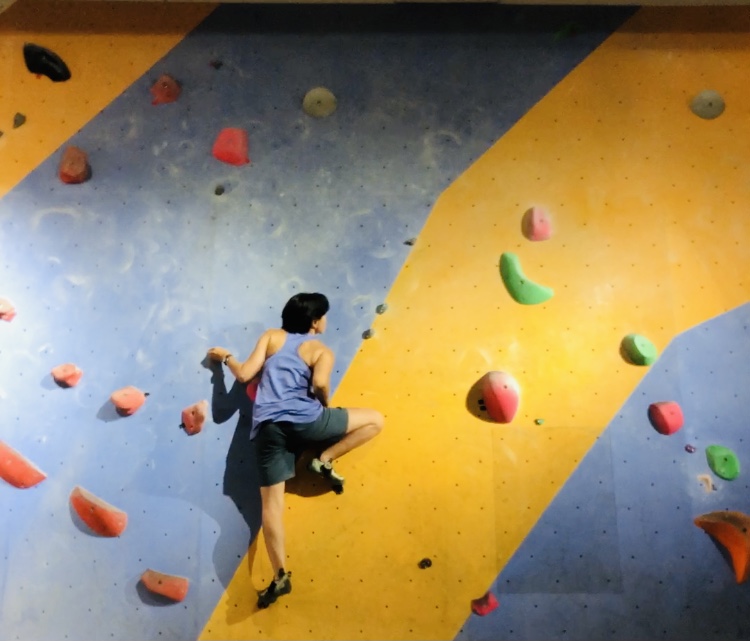
So… ‘What would it be like to… take up ballet?’ I’m a rock climber for many years now and in the climbing world, bouldering was often called ‘vertical ballet’: a blend of muscular strength and suppleness on a steep wall, balancing on your toes (or even just a big toe) on the tiniest of rock edges. I wanted to see what that was like for myself. So, around the time of the coronavirus pandemic, I signed up for ballet classes to give it a try. And treat myself with new experiences.
The result? Well, as a small group of adults, we were the ‘clumsy ones’ of the ballet studio, so to speak. At this particular school, teenagers were being groomed to move on to the ballet academy (the royal conservatory in The Hague). Yet, I felt very proud; we didn’t do too badly at all – if I may say so. I regained my flexibility (I used to do gymnastics as a kid, and I still had my strong climber’s legs, of course). After the initial intensive lessons, I made real progress. My climbing fitness strength, flexibility, and balance…, gave me an advantage. But above all, I embraced the challenge of improving. I found myself oftenly thinking about ballet even on days without ballet classes. It’s because my body is constantly moving, and I therefor became acutely aware of my posture and movements. Sometimes I would even do exercises in between, like the *relevé* (rising onto the toes and straightening the legs). – while cooking or waiting at a bus stop. Just like the *plié* (knee bends) or the *tendu*. And same goes for watching movies in the living room; I practiced the pirouette over and over – until it actually started to look like something like a pirouette. Of course, I had to spin quickly, or else I’d miss a scene from the movie. Yet, I also encountered something about the ballet world that put me off: the perfectionism and the (negative) attitude of the instructor. I can’t say it was necessarily down to the teaching style of that one specific instructor I tried three dance schools (two for ballet, one for modern dance), and I had essentially the same experience at all of them. I stuck it out the longest with the last instructor, as he was the most positive and constructive with his criticism. But ultimately, the negativity grew the longer we knew each other. The message was clearly that we were moving far too slowly. Perhaps the instructor didn’t enjoy teaching our little group, and I could sense that? In any case, things always moved far too slowly for this ballet teacher. And it was never perfect. Of course, how ever could it be. But to be fair: ballet only looks beautifully if you execute it perfectly. Otherwise, it doesn’t. It just doesn’t. That constant striving for perfection just didn’t suit me. I like living in a world where mistakes are allowed to exist (in fact, as an artist, I consciously seek out mistakes, failures, and “happy accidents” because they bring me new experiences, and I enjoy that).
Actually, I rather prefer living in a world where it’s okay to look like a complete idiot on the dance floor. Rock on! Who cares? Still, that period of dancing was a remarkable physical experience. Moving my body through space, in the most elegant way and in a way I’d never done before. And pushing my body to its absolute limits. In ballet, every single muscle gets involved. All of them! So, the arms and torso are involved too, even when it appears that only the feet and lower legs are doing the work.
It felt aesthetic and pureness. I could literally experience the beauty of dance and find joy in that alone. That feeling is comparable to the pleasure I derive from climbing movements on a rock face or a climbing wall. Poetry was no longer just something I could see, read, or hear; I could now feel it with my body – specifically when dancing, but also during everyday actions. Never ever before had pouring a cup of tea or carrying groceries felt like an act of poetry. The same applied to tying up my shoelaces and zipping up my winter coat: just look how elegantly this looks! “Straight back, shoulders down, chest out, and keep that upper body upright – in everything you do. And keep your toes pointed! Elbows and arms high and wide, as if you’re holding on to a beach ball. And please pay attention to the position of your fingers, especially your little pinky finger.”
Compared to ballet, executing ‘perfect’ climbing movements is purely functional. It ensures efficiency, meaning your muscles last longer and you don’t burn out as quickly. And it makes it easier to overcome a difficult section or passage, such as an overhang. Yet, performing these efficient climbing movements, which look technically perfect, is not merely about achieving a goal; it also has an aesthetic aspect. There is a great beauty in watching a climber move with such efficiency and technical perfection. As a climber, I can experience that beauty firsthand by applying the right technique and climbing efficiently. It is like a vertical dance. A vertical ballet, after all.




Leave a Reply